Compliance and legal advice dominate
49 of 101 included advertisements sit in Compliance / Privacy Governance or Legal Privacy Counsel.
What 167 Australian job advertisements reveal about how organisations describe, hire and structure privacy work.
A study of advertised demand, read against the four levels of The Privacy Capability Framework.
Free to read. No sign-up. The report is 42 pages; the full review is 106.
Role descriptions name the expertise. They are much less explicit about when privacy enters a decision and who must answer the judgement.
49 of 101 included advertisements sit in Compliance / Privacy Governance or Legal Privacy Counsel.
17 of 101 roles sit in Operational Privacy. Senior roles are often project-shaped; expertise is clearer than authority.
3 of 101 roles sit in Risk / GRC Privacy. None describes a clean second-line privacy challenge function.
Seven populated archetypes classify primary role scope, rather than job titles.
The review reads each advertisement against the four levels of The Privacy Capability Framework. A job advertisement cannot show what a practitioner can do, but it does signal the level the organisation is asking for, so every role was coded into an advertised band, L1 to L4.
Identifies the applicable obligation and recognises when the text does not answer the question.
Accurate identification of requirements and disciplined escalation.
Applies professional privacy method consistently to produce credible work.
Application of professional method to produce credible work and run established processes.
Finds the consequential choice and develops an alternative the business could actually use.
Business access provides exposure; it does not prove judgement, alternatives or unresolved risk ownership.
Works on the organisational system that keeps producing privacy outcomes.
The band combines operating-model, judgement, leadership and authority language. The audit tests whether it evidences shaping recurring decision conditions.
The bands were coded in May and June 2026, before the framework reached its final form in August, and are kept unchanged so the corpus stays reproducible. On this page L1 to L4 always mean the advertised bands; framework levels are written out in full. Read the framework →
The evidence extends beyond the included privacy-focused roles and requires careful interpretation of senior capability signals.
Privacy-led, data-led and standalone functions coexist. The corpus establishes no winning pattern. The choice depends on what existing functions can carry.
50 roles are coded L3 and 28 L4. L3 signals operational embedding, not proof of Risk-Disciplined Judgement. L4 combines leadership, authority and judgement signals, not proof of System Shaping.
The secondary reading finds no evidenced mandate to change the organisation’s own decision conditions under the report’s test.
43 roles name privacy inside adjacent functions: 26% of 167 raw captures, rounded. The other 12 near misses do not support the absorption finding.
Even roles closest to the business rarely specify when privacy enters a decision or who must engage with the judgement. Operational access does not establish authority to change how the decision is made.
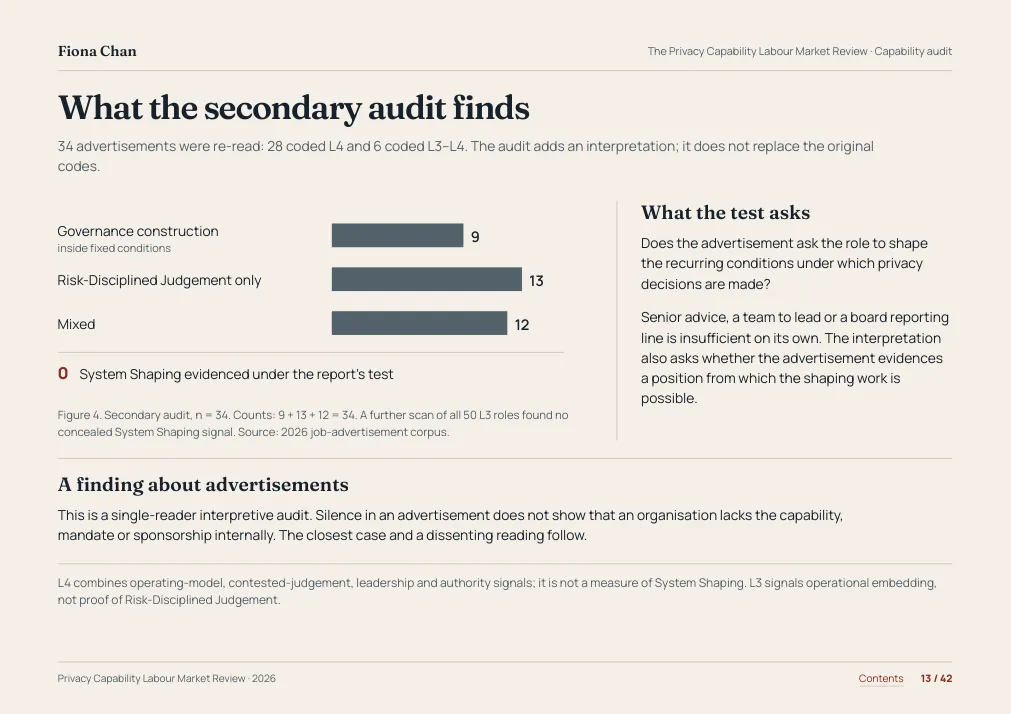
System Shaping, the framework’s fourth level, means shaping the recurring conditions under which privacy decisions are made. 34 advertisements were re-read against it: 28 coded L4 and 6 coded L3–L4. The audit adds an interpretation; it does not replace the original codes.
The L4 signals in these advertisements are mostly leadership, authority and difficult judgement. None of them is System Shaping as the framework defines it: a System Shaping practitioner usually works through the organisation’s existing initiatives, forums and sponsors, and needs influence rather than a title. Even setting authority aside, no advertisement describes the work of shaping the conditions in which privacy decisions are made.
The other 12 near misses are search false positives, not evidence of privacy responsibility being absorbed.
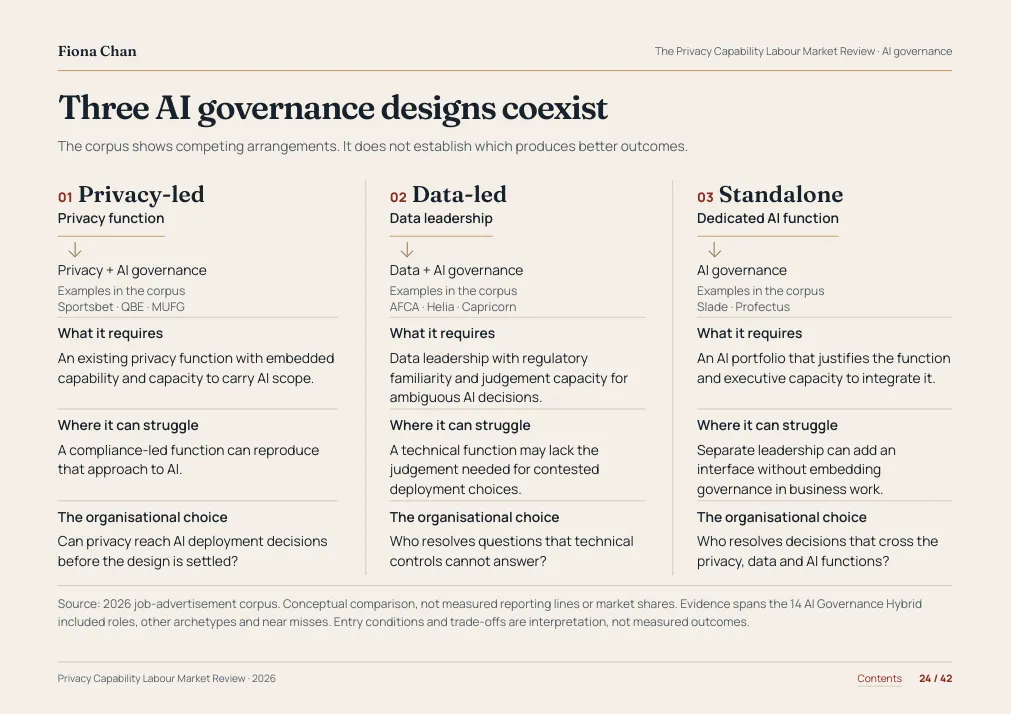
The corpus shows competing arrangements. It does not establish which produces better outcomes.
Privacy functionPrivacy + AI governance
Examples in the corpus Sportsbet · QBE · MUFG
Data leadershipData + AI governance
Examples in the corpus AFCA · Helia · Capricorn
Dedicated AI functionAI governance
Examples in the corpus Slade · Profectus
Source: 2026 job-advertisement corpus. Conceptual comparison, not measured reporting lines or market shares. Entry conditions and trade-offs are interpretation, not measured outcomes.
Design implications, not measured organisational outcomes. The corpus surfaces the choices; existing capability, risk exposure and decision volume determine the organisation’s answer.
Evidence. 49 compliance/legal roles versus 17 Operational Privacy roles in the 101 included roles.
Choice. Whether advice on request is sufficient, or privacy input needs a defined place in product, vendor and data decisions.
Evidence. Privacy-led, data-led and standalone designs coexist; the corpus establishes no winning pattern.
Choice. Which function can carry the work, and whether executives can integrate a new function with existing privacy and data governance.
Evidence. Senior cyber/security near misses absorb privacy or leave it out of the advertised scope.
Choice. Who has authority on each side of the interface, including during incident response, notification and remediation.
Evidence. 22 Legal Privacy Counsel roles; 15 broader legal near misses; 14 name privacy as one practice area.
Choice. Whether the privacy load requires dedicated counsel or can sit within a broader remit. The corpus provides no measured headcount threshold.
Evidence. 3 Risk / GRC Privacy roles in the 101 included roles; none describes a clean Line 2 function.
Choice. Build privacy-specific Line 2, use broader risk coverage or explicitly accept another model. Challenge complements Line 1 capability.
The eight findings, the capability audit, the AI governance designs, five organisational choices and the routes for practitioners, set out page by page for executives and senior practitioners.
Download the report ↓Every section in full: role inventories, the coding framework and crosswalk, the secondary audit, limitations and reproducibility notes. The version to cite.
Download the full review ↓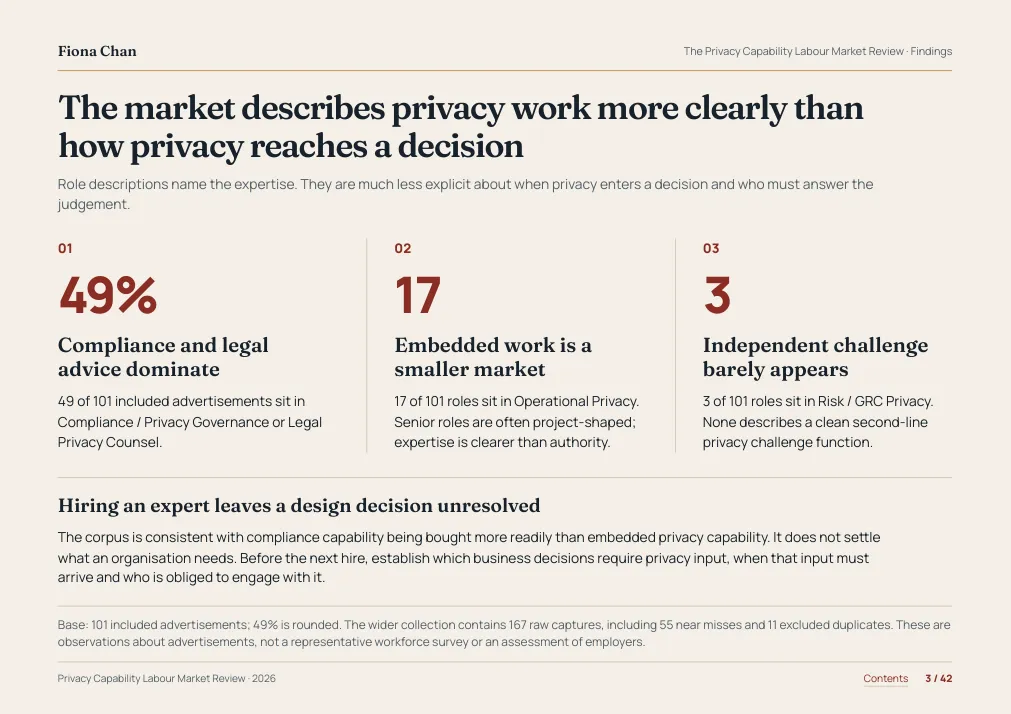
Read the findings, then the five organisational choices and the operating-model comparisons.
Read the embedded work and AI sections, then the career routes and capability implications.
Read the band crosswalk, the audit and its closest case, then the methodology and limitations in the full review.
167 raw captures were assembled manually in six sprints from 11 May to 2 June 2026. LinkedIn supplied 112, SEEK 46 and Indeed 9. Manual capture preceded AI assistance; no AI tool collected, scraped or generated advertisement content.
The corpus is neither a census nor a representative workforce survey. It does not measure salary distribution, time-to-fill, team size or operating effectiveness. Search strategy and the short collection window govern the interpretation of every count.
The findings concern advertised demand. They do not measure operating effectiveness or demonstrate the capability of appointed practitioners.
Both publications are free, with no sign-up.
Chan, F. (2026). The Privacy Capability Labour Market Review: What 167 Australian job advertisements reveal about how organisations describe, hire and structure privacy work. fiona-chan.com. https://fiona-chan.com/research/privacy-capability-labour-market-review/